

Private real estate is a cornerstone of long-term wealth strategies, offering key benefits such as portfolio diversification, lower volatility compared to public markets and attractive tax-advantaged income opportunities. We believe these characteristics make private real estate an important asset class for advisors aiming to help investors build resilient, multigenerational wealth through various market cycles.
To begin, here are 5 key themes to guide you on your real estate investment journey.
1. 70% of real estate is private!
The opportunity in private real estate is far more expansive than some investors realize. If you are investing exclusively in public real estate or even private real estate equity, you are missing out on a world of opportunity, particularly as the real estate sector undergoes transformational change.
Composition
Based on $ size of institutional U.S. real estate market

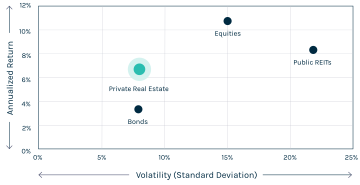
2. Opportunity for better risk-adjusted returns
Private real estate has historically offered lower volatility and superior risk-adjusted returns compared to equities, public REITs and bonds.
Effective source of portfolio diversification
3. Diversification benefits
Private real estate has demonstrated significantly lower correlation to public equity markets than public real estate. Private real estate had a 0.02 correlation to the S&P 500 Index over the past 20 years, and a negative correlation of 0.31 over the past 10 years.
Historical correlation
| Public equity | Public debt | Public REITs | Private RE | |
|---|---|---|---|---|
| Public equity | 1.00 | |||
| Public debt | -0.01 | 1.00 | ||
| Public REITs | 0.63vs. | 0.21 | 1.00 | |
| Private RE | 0.02 | -0.21 | 0.09 | 1.00 |
4. Protection against inflation
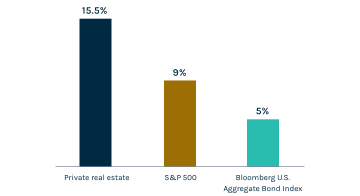
Real estate income growth, driven by rent escalation clauses and market rent increases, has historically outpaced inflation and performed well during periods of high inflation.
Historical return in high inflationary environments (%)
5. Tax benefits and generational wealth opportunities
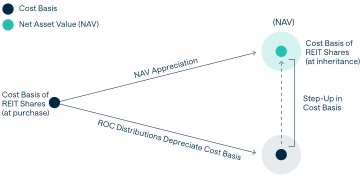
Certain private real estate investment vehicles (such as REITs) benefit from ROC, which can reduce the taxable portion of distributions due to depreciation and amortization. Under the Tax Cuts and Jobs Act, REIT investors receive a 20% deduction on ordinary income distributions. REITs also offer a tax-free step-up in cost basis on inherited shares, making REIT shares a valuable estate planning tool for investors and their heirs.
Hypothetical illustration of tax-free step-up in cost basis