



For families that directly own commercial real estate, depending on when it was acquired, its value has likely appreciated dramatically over their lifetime. Fortunately, this has contributed greatly to wealth that, ideally, will stay in the family.
How to keep that wealth in the family is potentially a hot-button intergenerational issue. Direct transfer can create division among family members with competing views and priorities. At AWMS, what we’re generally hearing from financial advisors and our private wealth clients is that younger generations do not want to own and actively manage direct real estate. They view owning and operating physical properties as a burden and an opportunity cost, as opposed to an opportunity to receive income, diversification and appreciation in the same way their parents, their grandparents and even their great-grandparents did.
With each passing year, an important decision looms: What is the optimal strategy for managing the transition of these real estate properties to the next generation?
We believe the tax and estate planning objectives of individual investors with appreciated real estate may be best served by utilizing a real estate exchange.
The importance of pre-planning for inherited real estate
Two commonly used transfer options include (1) gifting the property to heirs before death and (2) transferring the property to heirs upon death, with the latter option benefiting from a step-up in cost basis at the time of inheritance.
Either option also ends with heirs managing and maintaining a property they may not wish to own, and eventually taking on the burden of selling/liquidating the property and managing a potentially hefty tax bill.
As a result, pre-planning is crucial when transferring wealth built around physical real estate.
An alternative option is a real estate exchange. The market for real estate exchanges has significantly evolved such that today, tax-deferred exchange strategies are designed to support the intergenerational transfer of wealth within a family estate. Such exchange programs often culminate in an investor owning shares of a professionally managed real estate investment trust (or “REIT”) and are designed to be tax-efficient while also creating the potential for greater liquidity. Further, these types of programs can support portfolio diversification and help generate a potentially attractive risk-adjusted return that historically has low correlation to traditional investments across the rest of an individual’s or family’s investment portfolio or estate. In our experience, many investors find comfort in having access to a financial professional who can now advise on the investment.
Pre-planning is crucial when transferring wealth built around physical real estate.
Identifying the options: Liquidating and reinvesting after-tax proceeds versus liquidating into a real estate exchange
There is real value in deferring taxes. Here is a simplified example that compares selling the property for cash versus selling it via an exchange:
Bob, age 70, owns and operates an apartment complex that is worth $5 million. In conversations with his advisor around retirement and estate planning, he acknowledges that his children do not wish to continue managing the property. Let’s compare the results of Bob selling his real estate and reinvesting the after-tax proceeds with Bob completing a 1031 exchange.
Option #1: Sell property for cash, pay taxes, reinvest proceeds.
Bob sells the property for $5 million, writes a check for ~$1.4 million for taxes owed (capital gains + depreciation recapture + investment income tax + applicable state tax), and has ~$3.6 million left over to invest elsewhere. By selling the property, Bob frees himself from the financial burden, physical maintenance responsibilities and potential emotional stress. However, by selling before his passing and paying taxes on the original cost basis, Bob’s estate must absorb the impact of the opportunity cost of the tax hit (more on this below).
| $5 million Property Sale |
| ~$1.4 million Taxes owed |
| ~$3.6 million Remaining to invest |
Option #2: Exchange property, defer taxes, remain passively invested in real estate.
Bob sells the property for $5 million and, through a tax-deferred exchange, invests the proceeds in a diversified portfolio of properties held in a trust.
The original property is no longer a part of the estate, but the value of his ownership interest (equal to that of the property value) is. That $5 million may then grow (or shrink) with the rate of return of diversified private real estate held in the trust. Historically, this has been ~7%, mostly taken in the form of tax-advantaged income, as Bob is still able to take depreciation deductions against his share of the rental income distributed by the trust.
After two to three years, the value of the investment (still held by Bob) could potentially be transferred into shares of a semi-liquid, diversified private real estate vehicle via a 721-exchange transaction. At that time, Bob’s ownership interest (original $5 million +/- investment appreciation or depreciation) would be transferred into REIT operating partnership units. Bob is now effectively invested in the REIT (and diversified private real estate more generally) and receives all the potential benefits of ownership: tax-advantaged monthly income, diversification relative to traditional stocks and bonds, and potential liquidity through unit redemption and divisible ownership.
When the time comes, these units may be transferred to Bob’s heirs. His heirs either hold their REIT shares as a long-term investment or sell them after a defined period. No taxes are paid until the shares are sold. If Bob’s children receive the operating partnership units after Bob’s passing, they will experience a step-up in basis. This means that Bob’s children may sell their units and only pay taxes on any appreciation realized since Bob’s passing.
Evaluating the options: The economic value of staying invested in real estate
On the surface, the simplicity of Option #1 is appealing, and, particularly for wealthy families, a heavy tax bill is likely not a new concept. But what’s hidden is the opportunity cost of the $1.4 million in taxes remaining in the real estate market. There are two ways for private wealth advisors to think about this on behalf of their clients.
First, one can simply look at the difference in how much wealth Bob’s family would accumulate, assuming an equal rate of return (7%) between investing the after-tax proceeds ($3.6 million) and a real estate exchange ($5 million). All else being equal, after 10 years, Bob’s family would have $2.6 million more if they used the real estate exchange—a 38% difference!
| Invest after-tax proceeds | Sell into real estate exchange | |
|---|---|---|
| Property value | $5M | $5M |
| Taxes* | ($1.4M) | - |
| Proceeds to reinvest | $3.6M | $5M |
| Value after 10 years | $6.7M | $9.3M |
| $2.6M more! |
Another option is to look at how much return Bob would need on the reinvested after-tax proceeds ($3.6 million) to equal what he could potentially achieve through a $5 million 1031 exchange, assuming a 7% return.
Let’s examine this in more detail.
After two years, the $5 million in the exchange could have grown to $5.9 million. To end up with an equivalent amount from a starting point of $3.6 million, one would need annualized return of 24%!
After 10 years, the required annualized return on a $3.6 million investment today would be ~10%.
While the above is compelling on its own, consider as well that the expected 7% return on private diversified real estate comes with ~5% volatility.1 By comparison, expected return on public equity is ~8% with a volatility of 18%!2
Historical risk and return1
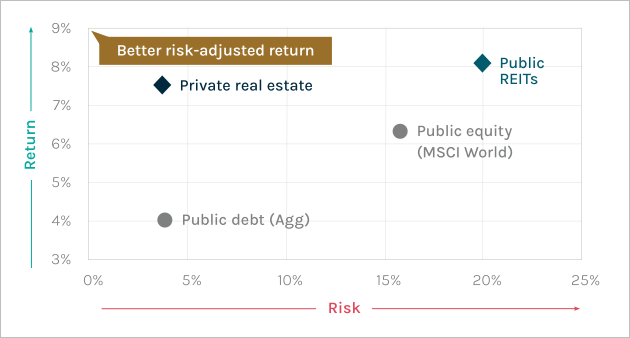
We believe the economic benefits alone of a 1031 + 721 exchange make them compelling options for financial advisors’ estate planning tool kits. In addition, this approach offers an elegant option to inject tax efficiency, potential liquidity and divisibility into an otherwise illiquid asset.
Own investment real estate with significant built-in gains
Are hesitant to sell due to high potential tax liability
Have recognized depreciation in their investment property for many years, further reducing the property's cost basis and increasing taxable gain
No longer wish to actively manage their investment property
Are looking to create and estate or tax planning strategy